NEW FEATURES OF THE CURRENT SITUATION OF THE MUONG LANGUAGE IN VIETNAM (related to the study of the Muong vocabulary system, in comparison and contrast with Vietnamese vocabulary)
DOI:
https://doi.org/10.68350/nnds.2026.11B(389).3022Từ khóa:
Language situation, Language attitudes, Muong language, Vietnamese language, influence, vocabularyTóm tắt
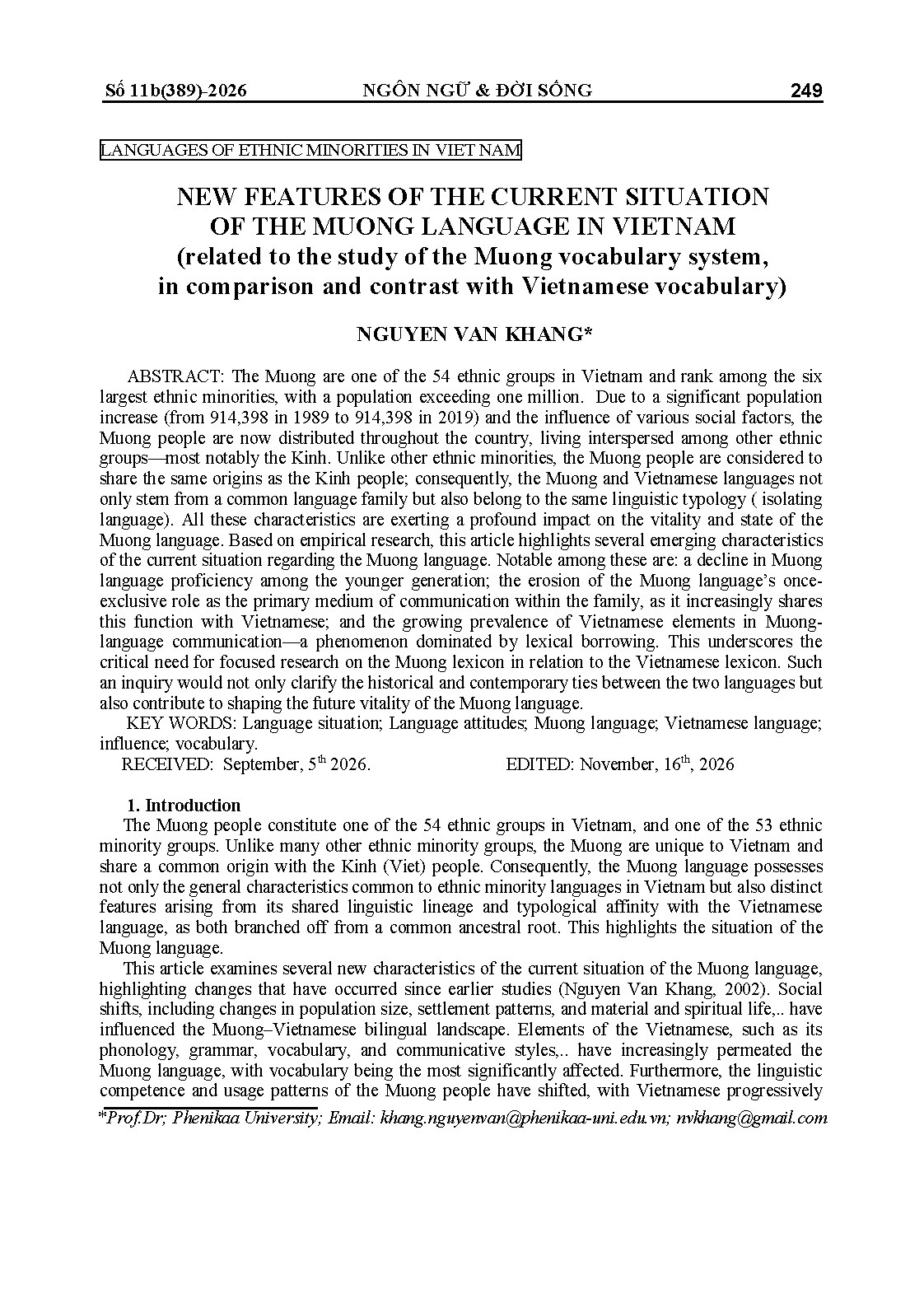
The Muong are one of the 54 ethnic groups in Vietnam and rank among the six largest ethnic minorities, with a population exceeding one million. Due to a significant population increase (from 914,398 in 1989 to 914,398 in 2019) and the influence of various social factors, the Muong people are now distributed throughout the country, living interspersed among other ethnic groups—most notably the Kinh. Unlike other ethnic minorities, the Muong people are considered to share the same origins as the Kinh people; consequently, the Muong and Vietnamese languages not only stem from a common language family but also belong to the same linguistic typology ( isolating language). All these characteristics are exerting a profound impact on the vitality and state of the Muong language. Based on empirical research, this article highlights several emerging characteristics of the current situation regarding the Muong language. Notable among these are: a decline in Muong language proficiency among the younger generation; the erosion of the Muong language’s onceexclusive role as the primary medium of communication within the family, as it increasingly shares this function with Vietnamese; and the growing prevalence of Vietnamese elements in Muong language communication—a phenomenon dominated by lexical borrowing. This underscores the critical need for focused research on the Muong lexicon in relation to the Vietnamese lexicon. Such an inquiry would not only clarify the historical and contemporary ties between the two languages but also contribute to shaping the future vitality of the Muong language.
Lượt tải xuống
Dữ liệu tải xuống chưa có.
Tài liệu tham khảo
Lượt tải xuống
Đã Xuất bản
27/11/2026
Số
Chuyên mục
NGÔN NGỮ CÁC DÂN TỘC THIỂU SỐ Ở VIỆT NAM